

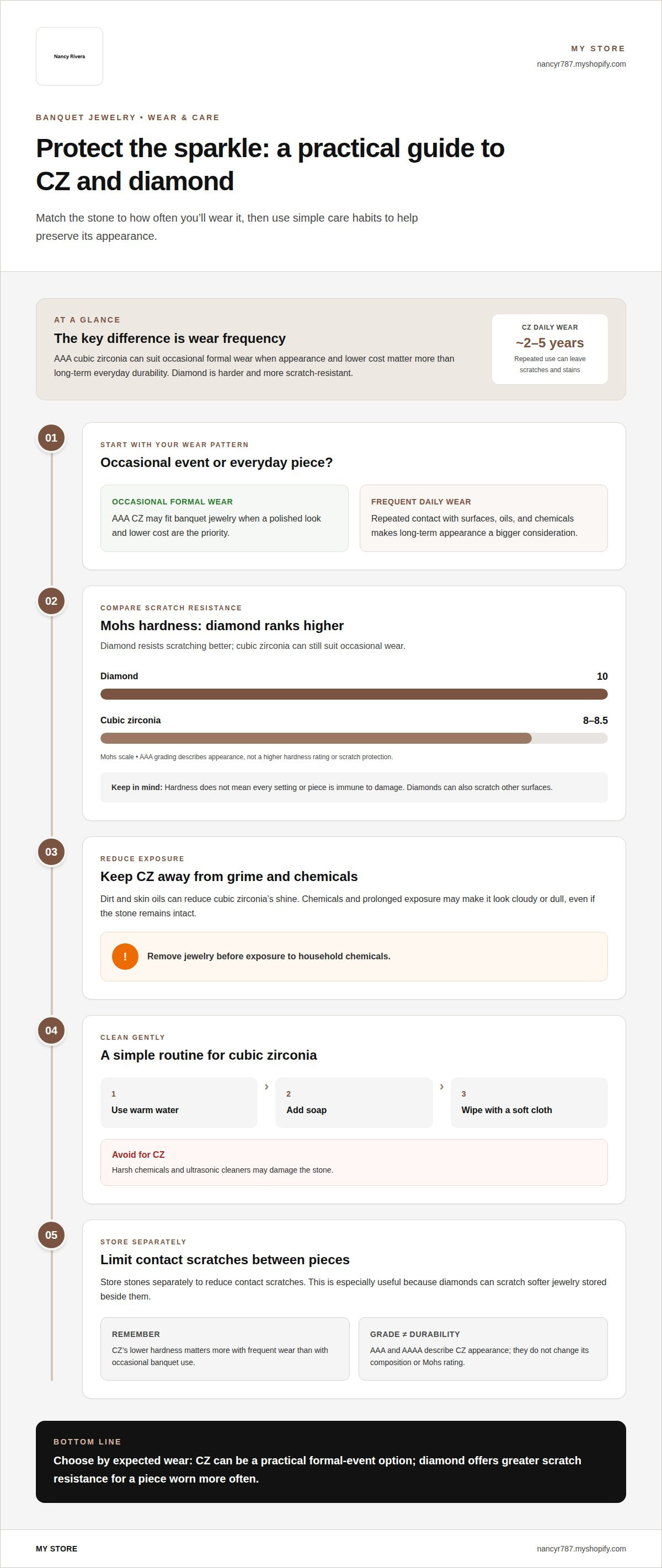
The harder stone isn't automatically the better choice for banquet jewelry. Diamond ranks 10 on the Mohs hardness scale, while cubic zirconia ranks 8-8.5, so diamond resists scratching better; AAA cubic zirconia can still suit occasional formal wear when appearance and lower cost matter more than long-term everyday durability.
Both choices can offer a bright, polished look, but they differ in material, wear over time, and price. The right fit depends on how often you plan to wear the piece and its exposure to dirt, oils, and chemicals. This comparison explains how AAA cubic zirconia and mined diamonds differ in price, hardness, durability, and everyday suitability, and which may better suit each use. Banquet jewelry worn occasionally has different demands from a piece worn every day, and that distinction matters when choosing between the two.
Key Takeaways
- Learn how cubic zirconia’s lab-made composition differs from mined diamond and what that means when choosing banquet jewelry.
- Compare the cost trade-off between a diamond-like appearance and long-term material value.
- Match each stone to its intended use by considering wear frequency, exposure to dirt and oils, and care needs.
- See when an AAA jewelry set designed for bridal banquets and dinners fits formal-occasion wear.
Diamond or Cubic Zirconia: Which Should You Choose?
For banquet jewelry, consider the material, origin, and intended use. AAA cubic zirconia and mined diamonds may look similar at a glance, but they are different materials.
Cubic Zirconia Composition and Creation
Cubic zirconia is zirconium dioxide, while diamonds are made of carbon. Naturally occurring cubic zirconia was identified in 1937, but most jewelry stones are created in laboratories. Laboratory production developed in the 1970s, making CZ a synthetic diamond simulant rather than a diamond. AAA and AAAA labels describe cubic zirconia grades associated with brilliance and a near-flawless appearance. They do not change the stone’s composition.
Cubic Zirconia and Mined Diamond Impacts
The main distinction in origin is that cubic zirconia is generally lab-created, while mined diamonds are extracted from the earth. That identifies the production pathway, but does not establish every impact or ethical condition for an individual stone. Lab-grown diamonds are also created in a laboratory and are described as conflict-free because they are grown rather than mined. Origin is useful context, not a complete measure of impact.
| Option | Composition | Origin | Category |
|---|---|---|---|
| Cubic zirconia | Zirconium dioxide | Mainly laboratory-created | Diamond simulant |
| Mined diamond | Carbon | Extracted from the earth | Diamond |
| Lab-grown diamond | Carbon | Created using HPHT or CVD | Diamond |
Choose based on whether material identity or appearance matters most. Cubic zirconia can look clear and produce strong rainbow flashes, while diamond brilliance balances white and colored light. For a formal event, the AAA cubic zirconia vs mined diamond banquet jewelry decision can center on the desired look and the stone’s origin. The AAA cubic zirconia vs mined diamond banquet jewelry comparison also highlights an important distinction: a similar appearance does not make CZ a natural or lab-grown diamond.
Price comparison
Cubic zirconia generally costs less than diamond, but the stone material is only one part of the decision. Appearance, intended use, and resale considerations also shape the value comparison.
Cubic Zirconia and Diamond Prices
A price comparison of AAA cubic zirconia vs mined diamond banquet jewelry starts with the intended piece and how it will be worn. Cubic zirconia is typically the lower-cost option, while mined diamond prices depend on cut, clarity, and color as well as carat weight. Their appearance can overlap at a glance, but CZ produces stronger rainbow flashes, while diamond has more balanced brilliance.
Resale is another consideration. Flawless cubic zirconia is not as valuable as a flawless diamond, so resale may matter more for a long-term purchase. A CZ banquet accessory worn occasionally may suit shoppers focused on appearance and initial cost. For a piece intended for frequent wear or future resale, consider how material and quality affect its value over time.
Cubic Zirconia and Lab-Grown Diamonds
Lab-grown diamonds have the same carbon structure as mined diamonds; cubic zirconia is zirconium dioxide. Lab-grown stones are produced using HPHT or CVD methods and are diamonds, while CZ is a simulant. Lab-grown diamonds generally cost less than mined diamonds, while CZ is usually the lower-cost option. When comparing AAA cubic zirconia vs mined diamond banquet jewelry, consider intended use alongside material and price.
Moissanite is another distinct option. Its higher hardness and refractive index affect durability and sparkle compared with CZ. Consider whether your priority is a lower-cost formal accessory, diamond material identity, or another stone’s physical properties. The most useful price comparison weighs those priorities against expected wear, rather than treating similar appearance as equal value.
For formal events, banquet jewelry options provide another way to compare styles alongside stone type.
Hardness and durability
Cubic zirconia rates 8-8.5 on the Mohs scale; diamond rates 10. Clean CZ with warm water and soap, then wipe it with a soft cloth. Avoid harsh chemicals and ultrasonic cleaners, which may damage the stone.
Cubic Zirconia Durability
At 8-8.5 Mohs, cubic zirconia resists ordinary wear, but it scratches more easily than diamond. Repeated daily use can leave scratches and stains after about 2-5 years. Dirt, oils, and chemicals can also reduce its shine, and prolonged exposure may make the stone look cloudy or dull. These changes can affect appearance even when the stone remains intact.
Diamond Durability
Diamond’s 10 Mohs hardness makes it more scratch-resistant than cubic zirconia. Hardness does not mean that every setting or piece is immune to damage, but the stone itself is less prone to surface scratches. Diamonds can scratch other surfaces, so storage beside softer jewelry may also cause wear to those pieces.
For banquet jewelry worn occasionally, CZ’s lower hardness may matter less than it does for a ring worn every day. Frequency of use and exposure to chemicals and oils all influence how quickly its clarity and sparkle change. AAA grading describes appearance, not a higher Mohs rating or protection from scratches.
For either material, store stones separately to limit contact scratches. Remove jewelry before exposure to household chemicals, and clean CZ with mild soap and warm water. Wipe it gently with a soft cloth. Avoid ultrasonic cleaning and harsh chemicals for CZ, as either may damage the stone. These steps help preserve its surface and appearance.
Is Cubic Zirconia Good for Everyday Wear?
Cubic zirconia can suit everyday jewelry, but its lower hardness makes it more vulnerable to scratches than diamond. For banquet occasions, occasional wear means less repeated contact with surfaces, oils, and chemicals. An engagement ring worn daily faces more frequent exposure, making long-term appearance a greater consideration.
With regular use, dirt and skin oils can reduce CZ’s shine. Prolonged exposure to chemicals and everyday wear can also make the stone look cloudy or dull. Clean it with warm water and soap, then wipe it with a soft cloth. Avoid harsh chemicals and ultrasonic cleaners, which may damage the stone.
Facet edges offer another visible clue. Diamond facets usually look sharp and precise, while abraded or worn edges can suggest a stone isn’t a genuine diamond. CZ may become less clear over time, changing its appearance even when the setting remains intact. A colorless CZ can look bright at first, but clarity and surface condition affect how its sparkle holds up.
Moissanite is harder than CZ, while diamond has the greatest hardness among these stones. This difference matters most for frequently worn jewelry, where repeated contact can affect a softer gemstone sooner. For occasional formal wear, CZ can provide a bright appearance without needing the long-term durability of a daily engagement ring.
Choose CZ for banquet pieces worn occasionally and diamond for a piece expected to face frequent daily wear. For everyday use, remove jewelry before contact with chemicals and gently clean CZ after exposure to dirt or oils. These steps help maintain its appearance without changing the stone’s inherent hardness.
For formal occasions, browse banquet jewelry styles suited to dinner and bridal events.
MY STORE: AAA jewelry chain, bridal banquet, dinner Jewelry Set
MY STORE offers an AAA jewelry chain, bridal banquet, dinner Jewelry Set for formal-event dressing. It is a relevant option when selecting jewelry for a bridal banquet or dinner, rather than choosing a stone for daily wear. Use the earlier comparison to decide which qualities matter most for the occasion, such as appearance, expected wear frequency, and material preference. The listed set provides a jewelry category to consider alongside your outfit and event needs; no additional stone composition or durability specification is stated here. For a formal event, focus on the intended occasion and how often you expect to wear the pieces. Contact MY STORE for information about the AAA jewelry chain, bridal banquet, dinner Jewelry Set.
Choose Jewelry That Fits the Occasion
Before choosing a piece, consider how it will fit into your wardrobe beyond the event. Decide whether you want a distinctive formal accessory, a piece for repeated use, or a stone whose material identity matters as much as its appearance. Setting that priority first can make the choice more practical than judging sparkle alone.
For AAA cubic zirconia versus mined-diamond banquet jewelry, base the decision on intended use, the occasion, and the look you want with your outfit. If your priorities vary from one event to another, note them before choosing instead of treating one material as right for every setting. A clear preference makes the next step easier and keeps your choice aligned with your plans.
For a jewelry-related next step, discuss jewelry options with MY STORE. Move forward with a choice that suits how you plan to wear it.
Frequently Asked Questions
How Can You Tell Which Is Which?
Look at differences in light and surface details, but treat them as clues rather than proof. Cubic zirconia can show stronger rainbow flashes, while a diamond’s brilliance balances white and colored light. A CZ stone may also look unusually clear. In a ring or banquet set, lighting, cut, and setting affect what you see, so a quick visual comparison may not be conclusive.
What Does AAA Mean?
AAA is a quality label used for cubic zirconia, not a chemical composition or diamond designation. Retail descriptions associate AAA and AAAA CZ with strong brilliance and a near-flawless appearance. Because labels can vary between sellers, treat AAA as a description of the stone’s stated grade, not proof that it is a diamond or has diamond-level hardness.
What does AAA grade mean for cubic zirconia?
For cubic zirconia, AAA generally signals a high visual grade, particularly in brilliance and apparent clarity. It describes the CZ stone, not its origin or durability. An AAA label doesn’t change zirconium dioxide into carbon or identify the stone as a mined or lab-grown diamond. Judge the grade as a CZ classification, not as a direct equivalent to diamond grading.
How does AAA cubic zirconia compare with mined diamonds in brilliance, fire, and clarity?
AAA cubic zirconia produces stronger rainbow fire, with dispersion of 0.058-0.066, compared with diamond’s 0.044. Diamond has slightly more white-light brilliance, creating a more balanced sparkle. CZ is often colorless and typically lacks the tiny inclusions found in almost all diamonds. These differences affect appearance: CZ can look exceptionally clear, while inclusions are part of natural diamond’s characteristics.
What are current prices for AAA cubic zirconia and mined diamonds by carat size?
There isn’t one fixed price for each carat size. Cubic zirconia generally costs far less than mined diamond, while diamond pricing depends on carat weight, cut, clarity, and color. For a useful comparison, consider stones of the same size and account for those quality factors. Carat weight alone doesn’t establish equivalent appearance, value, or resale prospects.
How can you tell cubic zirconia from a mined diamond?
A jeweler or gemologist using appropriate equipment can identify a stone conclusively. Visual signs, such as rainbow flashes or apparent clarity, can suggest a difference but don’t establish origin. For example, a colorless CZ and a small diamond set in jewelry may look similar from a distance. Appearance alone can’t confirm whether a stone was mined.