

The most prominent piece isn’t always the most practical choice. Choosing jewelry depends on the occasion, design, and material. Engagement and wedding rings serve different roles from pendants, charms, and rice bead pieces.
Occasion and personal preference shape jewelry choices. This guide compares these categories, explains how gold and sterling silver affect a piece’s appearance, and highlights details that can help you narrow your selection.
Compare rings by purpose and design. Review pendants, charms, earrings, and rice bead pieces by form and how you plan to wear them. Then consider gold and sterling silver for formal or everyday jewelry. Use these distinctions to identify pieces that suit the occasion and your preferences.
Key Takeaways
- Separate engagement and wedding rings by their role and design before comparing options.
- Match pendants, charms, and earrings to the form and occasion you have in mind.
- Compare rice bead necklaces, bracelets, and rings by piece type and intended wear.
- Use material and occasion as practical filters when weighing gold, sterling silver, and a bridal or dinner set.
Engagement and wedding rings
Engagement rings and wedding bands mark related but distinct occasions. An engagement ring often features a central stone, while a wedding band is commonly a simpler ring worn to mark marriage. A matched set may coordinate both pieces, while separate designs create contrast. For example, pairing a stone-set engagement ring with a plain band creates a less detailed combination. Assess the rings separately before considering the full pairing.
Start with the intended role, then compare shape and setting. A solitaire focuses attention on one central stone. A halo places smaller stones around a central stone, creating a more detailed outline. A plain band has a smooth, uninterrupted surface, while a contoured band follows another ring’s curve. Compare these design details with the look you want for the occasion.
Next, consider how the rings will sit together. A straight band may sit close to an engagement ring with a level profile. A raised setting can leave a gap beside a straight band, so a curved or contoured band may create a closer fit. Compare the rings side by side, noting their profiles, widths, and surface details as a combination. These practical checks also help when assessing coordinated jewelry sets.
- For a minimal look: Pair a solitaire engagement ring with a plain wedding band.
- For a coordinated look: Choose related metal colors and repeated design details.
- For a contrasting look: Combine a detailed engagement ring with a smooth band.
Material affects a ring’s color and overall appearance. Gold offers a warm metallic finish, while sterling silver has a cooler tone. Stone choice and setting also change the visual balance. A larger-looking central stone draws more attention, while a narrow band keeps the design visually light. Compare each element before deciding, rather than choosing by the engagement ring alone. Apply the same approach to everyday jewelry by assessing the complete pairing, not just one piece.
Pendants, charms, and earrings
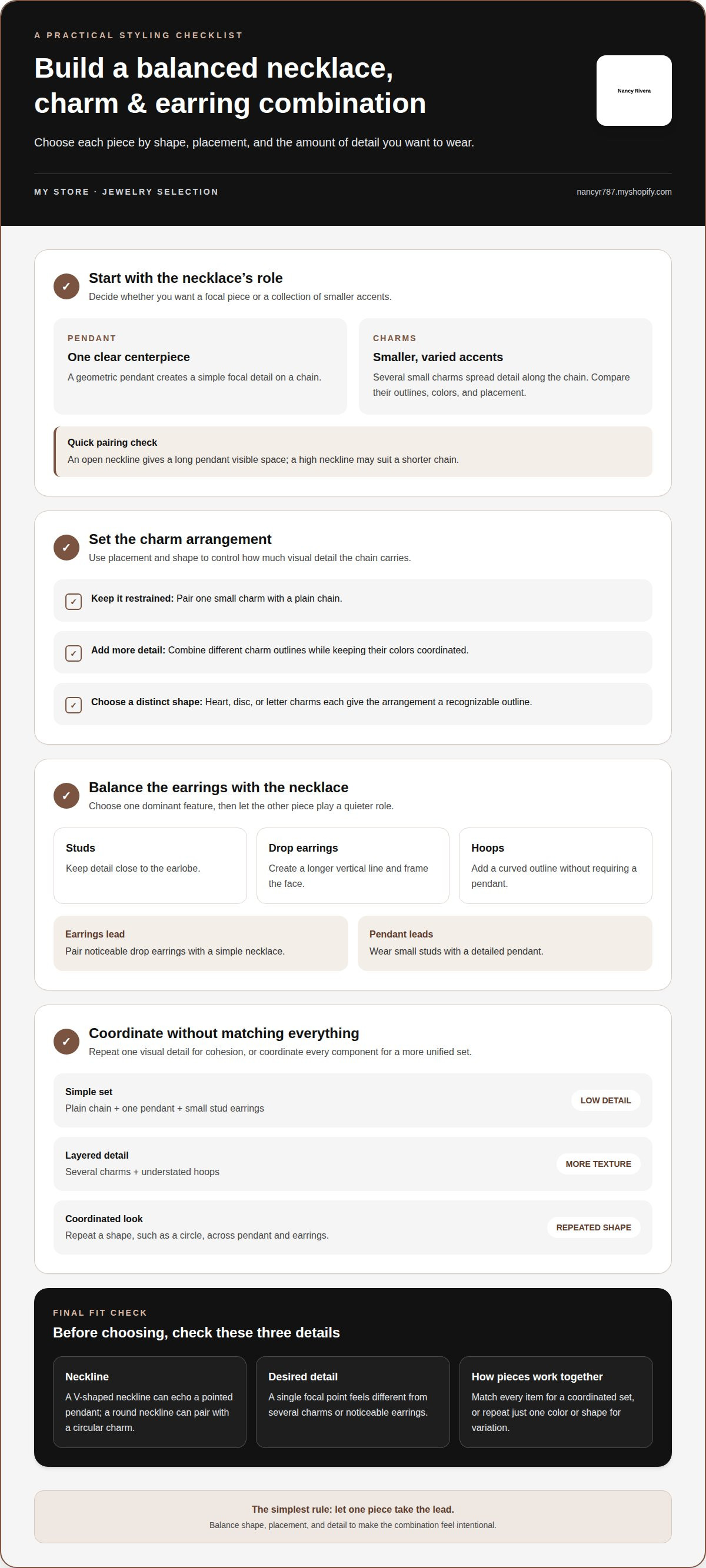
Pendants add a focal detail to a chain, while charms provide smaller accents. A geometric pendant creates a simple centerpiece; several small charms make a more varied arrangement. Compare each piece’s outline, color, and scale with your neckline and clothing. For example, an open neckline gives a long pendant visible space, while a high neckline may suit a shorter chain. These jewelry pieces can be selected individually or as coordinated accessories.
Charm placement affects how a necklace looks and moves. One charm keeps attention in a single area, while several spread detail along the chain. A heart, disc, or letter charm gives the arrangement a distinct shape. Pair one small charm with a plain chain for a restrained look. For more detail, combine different charm outlines while keeping their colors coordinated. This helps jewelry combinations look intentional without matching every component.
Earrings frame the face and can balance a pendant. Studs keep detail close to the earlobe, while drop earrings create a longer vertical line. Hoops add a curved outline without requiring a pendant. Choose one dominant feature: pair noticeable drop earrings with a simple necklace, or wear small studs with a detailed pendant.
- For a simple set: Choose a plain chain, one pendant, and small stud earrings.
- For layered detail: Combine several charms with understated hoops.
- For a coordinated look: Repeat a shape, such as a circle, across the pendant and earrings.
Before choosing, consider the neckline, desired detail, and whether pieces need to work together. A V-shaped neckline can echo a pointed pendant, while a round neckline can pair with a circular charm. Matching every item creates a coordinated set; repeating one color or shape adds variation. Browse the jewelry collection to compare pieces by shape, detail, and intended use.
Rice bead necklaces, bracelets, and rings
Rice bead pieces use small, elongated beads with a grain-like outline. Their repeated shape creates a fine, textured surface across a necklace, bracelet, or ring. A necklace shows the pattern over a larger area, while a bracelet places it close to the wrist. A ring concentrates the detail into a smaller area. Compare the piece’s scale with the part of your outfit it will occupy.
For a necklace, consider its length, bead density, and how the strand sits against clothing. A close-fitting style keeps the pattern near the neckline; a longer strand places it lower on the torso. A bracelet is more compact, making the bead texture a wrist detail. A ring works as a smaller accent and can be worn alone or alongside other simple pieces. These are visual comparisons, not rules about how pieces must be worn.
Use the intended setting to guide the choice. A rice bead necklace can provide the main detail with plain clothing, while a bracelet adds texture without a prominent neckline piece. For a coordinated set, repeat the rice bead pattern across two pieces, such as a necklace and bracelet. For a less uniform combination, pair one rice bead item with a smooth, simple accessory. Keep the patterned piece as the focal point.
- Necklace: Compare where the strand falls against the neckline and garment.
- Bracelet: Choose this form when wrist-level detail suits the outfit.
- Ring: Use the compact bead pattern as a smaller accent.
Before choosing, compare the bead shape, overall density, and placement. A tightly repeated pattern looks different from one with more visible spacing. Consider whether the item should stand alone or coordinate with another accessory. For example, a rice bead bracelet can complement a plain necklace without repeating the same texture. Shape and placement are practical selection criteria for everyday jewelry and occasion wear.
Gold and sterling silver jewelry
Gold and sterling silver differ in color and stated metal composition. Compare the material, occasion, and care needs before choosing a piece.
Occasion and Gift Selection
For a wedding dinner, a coordinated necklace and earrings can complement formal clothing. For daily wear, a simple pendant or small earrings offer a more subtle accent. As a gift, consider the recipient’s usual metal color, preferred piece type, and clothing style. A gold-tone choice may suit someone who regularly wears warm colors, while sterling silver offers a cooler look.
Labeling and Metal Purity
In the United States, read the product description alongside any metal purity mark. Check whether the description identifies gold, sterling silver, or a surface finish, and compare that wording with any stamp. A mark alone may not describe every part of a piece. For example, a chain and pendant may use different materials, so look for information about each component.
Cleaning and Jewelry Care
Care depends on the material and attached details. Wipe a plain metal band with a soft, dry cloth after wear, and store it separately to limit scratches. For a stone-set pendant, avoid scrubbing the setting with a rough cloth. Keep each piece in a separate pouch or compartment, and follow any care directions supplied with the item.
Quality, Authenticity, and Certification
Assess quality by inspecting joins, clasps, settings, and finish. Compare any stated metal or stone description with the product documentation, and check which item a certification covers. Online and secondhand purchases can involve incomplete descriptions, unclear condition, or differences between images and the item received. Resizing, repair, and appraisal require an assessment of the piece’s material, construction, and condition, especially around settings and joins.
Compare occasion-ready options and materials in the jewelry collection.
MY STORE: AAA jewelry chain, bridal banquet, dinner Jewelry Set
MY STORE offers the AAA jewelry chain, bridal banquet, dinner Jewelry Set for readers considering accessories for wedding celebrations or dinner occasions. Use the occasion and outfit as practical selection criteria. Compare the set’s listed category with the formality and color of the clothing you plan to wear, then decide whether a coordinated set suits the look.
This set is an occasion-based jewelry option for bridal banquets and dinners. It provides a specific choice to consider after comparing ring styles, accessories, and metals. Focus on the event and overall outfit rather than assuming details beyond the product name.
Explore the AAA jewelry chain, bridal banquet, dinner Jewelry Set at MY STORE.
Choose the Next Piece
Make your next selection around one clear purpose: completing an outfit, marking an occasion, or choosing a gift. Decide which visual detail should lead, then keep other accessories secondary. This gives your final choice a practical focus without requiring every piece to match.
MY STORE also offers the 2026 Men S Fashion Waffle Knit Ribbed Sleeve V Neck Short Sleeve T Shirt For Daily Commuting And Casual Wear and Arrival Versatile Off-shoulder Knit Womens Wear. These apparel options provide outfit categories to consider alongside an accessory choice. The AAA jewelry chain, bridal banquet, dinner Jewelry Set remains an occasion-based option for formal events.
Use the intended setting and clothing as filters, then select a piece that fits the planned look. For the next step, contact MY STORE about jewelry. Choose the option that best fits the occasion and your preferred style.
Frequently Asked Questions
What materials and gemstones are commonly used in jewelry?
Common materials include gold, sterling silver, platinum, and stainless steel. Gemstone choices include diamonds, sapphires, rubies, emeralds, and pearls. The material affects a piece’s color and finish, while a gemstone adds color, texture, or a focal point. For example, a pearl pendant looks different from a silver pendant set with a colored stone.
How can you tell if jewelry is real gold, silver, or platinum?
Check the piece’s metal marks and product documents, then compare them for consistent descriptions. A stamp can provide a clue, but appearance alone can’t establish metal content. If the marks or documents don’t clearly identify the material, arrange a professional metal test before treating the piece as solid gold, silver, or platinum. Don’t rely on color or weight alone.
How can you get jewelry resized, repaired, or appraised?
Have the piece assessed for its material, construction, and condition before resizing, repair, or appraisal, especially around settings and joins.