

Accessories change how an outfit reads without replacing its main pieces. They add color, texture, or a point of focus, while scarves and scarf necklaces can serve different styling needs across casual, work, and occasion wear. Browsing fashion accessories online makes it easier to consider these options alongside the clothes they’ll complement.
Choosing accessories for a specific occasion starts with the setting, outfit, and amount of detail you prefer. A scarf adds color or texture, while a scarf necklace creates a decorative focal point. Choose the piece that works best with the rest of your look.
This guide explains how women’s fashion accessories can complement different outfits and occasions. It covers scarves, scarf necklaces, and other accessory types, with practical tips for matching appearance and function to the setting.
Key Takeaways
- Match accessories to the setting, outfit, and level of formality to make each choice feel appropriate.
- Use scarves for added color or texture, and scarf necklaces when a decorative focal point suits the look.
- Choose occasion accessories by considering comfort, practicality, and how each item works with the rest of the outfit.
- When shopping for designer pieces online, examine product details and seller information before making a selection.
Accessories for different contexts
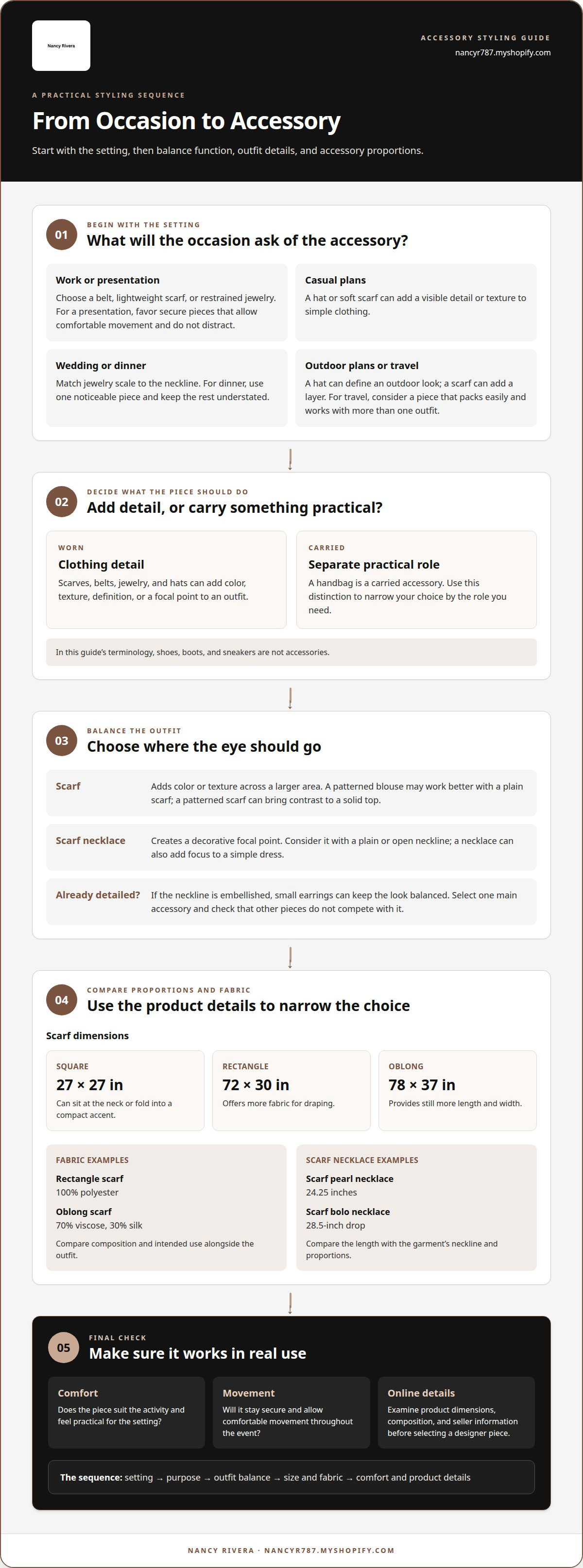
An accessory works best when it suits the place, activity, and outfit. A structured belt can define the waist in a work outfit, while a soft scarf adds texture to casual clothing. For an evening gathering, a necklace can create a focal point without changing the outfit itself. Start with the setting, then consider comfort, movement, and how much detail feels right.
Accessories generally fall into two groups: items you carry and items you wear. Scarves, belts, jewelry, and hats are worn; a handbag is carried. Shoes, boots, and sneakers are not accessories in this article’s terminology. This distinction can narrow your search: choose a worn piece to add detail to clothing, or a carried item for a separate practical role.
The word “accessory” came into use in the 16th century. In early 16th-century Italy, civilian men of higher social status wore decorative hat badges. They imitated badges worn on invading military caps. This example shows how context can shape an accessory’s meaning. A decorative item can signal style, status, or influence, so its suitability depends on more than color coordination.
Victorian fashion offers a historical example of accessories reflecting social expectations. Fans, parasols, and gloves figured in women’s experiences of gender, race, and class. Women often wore gloves to cover their hands and mask signs of labour. After wrist watches became fashionable, women in Victorian England wore slide bracelets. These examples show that accessories can reflect social norms as well as complete an outfit.
Use a simple selection process for current settings:
- Work: Choose a belt, scarf, or restrained jewelry that suits the outfit and daily movement.
- Casual plans: Use a hat or scarf to add a visible detail to simple clothing.
- Formal events: Select one focal piece, such as a necklace, and keep other details balanced.
Economic status and religious or cultural background can also influence accessory choices. A scarf may carry personal or cultural meaning, while a belt may meet a practical clothing need. Consider the wearer and setting before choosing. When shopping for fashion accessories online, compare each item’s shape, color, and role with the outfit and occasion.
Accessories for different occasions
The occasion helps determine how much decoration an outfit can carry comfortably. For a daytime wedding, a scarf necklace can add a focal detail to a simple dress. If the neckline is already embellished, small earrings can keep the look balanced. For an evening dinner, choose one noticeable piece, such as a necklace or bracelet, and keep the rest understated.
For work events, choose pieces that suit the setting and remain practical throughout the day. A lightweight scarf can add color to a plain blouse without changing its shape. A belt can define the waist of a dress or trousers. For a presentation, select accessories that stay secure and do not distract as you move or handle materials.
Outdoor plans bring different considerations. At a garden gathering, a hat can complement a dress and give the outfit a defined silhouette. A scarf adds a layer to casual clothing during a breezy walk. For travel, choose accessories that pack easily and work with more than one outfit, such as a neutral scarf that pairs with a daytime top or evening dress.
- Wedding: Match jewelry scale to the neckline and dress details.
- Dinner: Use one statement accessory with simpler clothing.
- Work event: Choose secure pieces that allow comfortable movement.
- Outdoor gathering: Coordinate a hat or scarf with the outfit’s colors.
- Travel day: Select a versatile piece that pairs with several looks.
Before choosing, identify the event’s dress level, expected activity, and outfit colors. Then select one main accessory and check whether other pieces compete with it. A scarf necklace suits an open neckline, while a patterned scarf can bring contrast to a solid top. For occasion-ready combinations, browse jewelry and clothing options and consider how each piece fits the event.
Women's fashion accessories
Women’s accessories include scarves, scarf necklaces, jewelry, belts, and headwear, each adding a different kind of detail. A scarf changes color and texture across a larger area, while a necklace creates a smaller focal point. Consider the outfit’s neckline, pattern, and proportions. A patterned blouse may work better with a plain scarf, while a simple top can support a more decorative necklace.
Scarf dimensions affect how the fabric can be worn. A square scarf measuring 27 by 27 inches can sit at the neck or fold into a compact accent. A rectangle measuring 72 by 30 inches offers more fabric for draping. An oblong scarf measuring 78 by 37 inches provides still more length and width. These measurements help compare shape and coverage before choosing a style.
Material also changes the look and feel. A rectangle scarf made from 100% polyester differs in composition from an oblong scarf made from 70% viscose and 30% silk. Consider the fabric alongside the outfit and intended use. A smooth, lightweight fabric can create a different finish from a fabric with more texture. Product dimensions and composition offer practical comparison points when browsing.
Scarf necklaces combine fabric-like detail with a jewelry form. A scarf pearl necklace measuring 24.25 inches gives a reference for necklace length. A scarf bolo necklace with a 28.5-inch drop creates a longer vertical line. Compare the drop with the garment’s neckline and length. A shorter necklace can sit closer to the collar, while a longer drop draws attention down the front of an outfit.
- For a patterned outfit: Choose a simpler accessory to avoid competing details.
- For a plain neckline: Consider a scarf necklace as the focal piece.
- For scarf selection: Compare measurements and fabric composition before styling.
Choose accessories by scale, material, and placement, not just category. Compare a scarf’s dimensions or a necklace’s length with the outfit to judge how each piece will look and sit.
What should I know about buying designer accessories online and avoiding counterfeits?
Designer accessories call for careful scrutiny, especially when a style is unfamiliar. A listing may show a brand name, logo, or product photograph without proving authenticity. Assess the description, seller identity, product images, and purchase terms separately. No single feature, including branded packaging, establishes that an item is genuine.
Start with the listing. Read the full product description and note the named model, materials, dimensions, and included components. Compare these details with the brand’s official product information. Check whether features such as the clasp, logo placement, and color match the described design. Differences can have legitimate explanations, but unexplained inconsistencies warrant caution.
- Review the seller: Check the seller name, business details, and stated return terms.
- Inspect images: Look for clear views of labels, hardware, stitching, and finishes.
- Read the description: Compare the named model and materials with brand information.
- Keep records: Save the listing description and order confirmation for reference.
Pay attention to vague wording. Terms such as “inspired,” “style,” or “look” may describe an aesthetic rather than a brand-made item. A product page that names a designer but gives no model or material details offers little basis for comparison. Look for clear product photos that show the actual design, not just a distant styled image.
Read the return and refund terms before ordering. Note the return window, item-condition requirements, and process stated in the listing. Keep the order confirmation and any seller messages together. These steps help document what was represented if the delivered item differs from its description.
For non-designer alternatives, assess clothing by its stated style and construction rather than a luxury label. Compare the neckline, knit texture, and fit details of an off-shoulder top with the outfit you plan to wear. Browse women’s knitwear options for a clothing choice that does not depend on designer authentication.
MY STORE: 2026 Men S Fashion Waffle Knit Ribbed Sleeve V Neck Short Sleeve T Shirt For Daily Commuting And Casual Wear
MY STORE offers clothing and accessory options for completing everyday and occasion outfits. The 2026 Men S Fashion Waffle Knit Ribbed Sleeve V Neck Short Sleeve T Shirt For Daily Commuting And Casual Wear suits casual outfit planning, while Arrival Versatile Off-shoulder Knit Womens Wear offers a women’s clothing option. For a formal event, the AAA jewelry chain, bridal banquet, dinner Jewelry Set provides a jewelry set category.
Start with what the outfit needs: casual wear, a women’s knit top, or jewelry for a banquet or dinner. These options offer a practical starting point for coordinating clothing and accessories across different occasions.
For help with a product or order, contact MY STORE.
Build Your Next Accessory Rotation
Start with an outfit you already wear, then choose accessories with distinct roles. One piece can add color, another can provide a focal detail, and a third can support the outfit’s overall shape. This approach creates variety without requiring a wardrobe change. Keep the occasion and the clothing’s existing patterns in mind as you choose.
When shopping for fashion accessories online, focus on the details that affect how each piece works with your wardrobe: shape, material, scale, and placement. Choose items that coordinate with clothes you already wear, rather than judging by appearance alone. A clear purpose also makes each piece easier to style again.
Use this approach to identify the next gap in your wardrobe, whether it’s an outfit for a dinner or an everyday clothing option. For questions about available items, contact MY STORE. Make your next selection with a specific outfit and occasion in mind.
Frequently Asked Questions
Why are accessories important to fashion?
Accessories extend the use of existing clothes by changing an outfit’s finish without replacing its main pieces. The same plain shirt, for example, can look different with a belt, cap, or jewelry. Choices of color, shape, and scale also express personal style. Select pieces that work with several garments to create more outfit combinations.
What types of fashion accessories are available to buy online?
Online selections can include jewelry, belts, and caps, alongside clothing that helps complete an outfit. MY STORE offers baseball caps for men and women, a black jeans belt, and an AAA jewelry chain set for bridal banquets and dinners. Apparel options include men’s wear and an off-shoulder knit women’s top. To make a practical choice, start with the category your planned outfit is missing.
How can I check sizing and fit for jewelry, hats, belts, and bags online?
Compare a necklace’s listed length or drop with the neckline, and belt measurements with the intended placement. Review product dimensions before choosing. For hats or bags, check the product details for the measurements you need.
How can I find customer reviews and reliable product photos for online accessories?
Look for clear product photos showing labels, hardware, stitching, and finishes, then compare them with the description. Save the listing and order confirmation. Branded packaging alone does not establish authenticity.