

Size labels are only a starting point: one off shoulder knit top size chart runs from XS to L. Across those sizes, bust measurements are 67, 76, 84, and 93 cm; waist measurements are 55, 63, 72, and 80 cm; hip measurements are 72, 80, 88, and 97 cm. The top is approximately 47 cm long in every size.
Choosing a size involves more than matching a label. Compare your body measurements with the size chart to see where the fit may be close or relaxed, and check the garment length to gauge where the hem will sit.
This guide explains how to measure your bust, waist, and hips, use the listed size range, and interpret garment length. It also shows how the top’s measurements relate to fit, helping you make a more informed choice when browsing off-shoulder knitwear.
Key Takeaways
- Use the size chart’s measurements rather than relying on a familiar label, since sizing can vary between garments.
- Measure your bust, waist, and hips at their fullest points, keeping the tape level and comfortably close to the body.
- Compare your measurements with the garment chart and consider the intended close fit when choosing between sizes.
- Use the stated garment length to estimate hem placement, and consider how the off-shoulder neckline will sit when worn.
Available sizes
The size range covered here runs from XS through L: XS, S, M, and L. These are four consecutive labels, with no sizes between the listed options. Use the range as a starting point for comparing the garment’s measurements with your own. A familiar letter size alone cannot tell you how a particular knit top will fit.
The listed hip circumferences increase across the range: 72 cm for XS, 80 cm for S, 88 cm for M, and 97 cm for L. The increases are not identical between every adjacent size. For example, the difference between M and L is larger than the difference between XS and S. Compare the actual measurements rather than assuming each size step adds the same amount.
- XS: Listed hip circumference, 72 cm. Compare the chart with your measurements before selecting this label.
- S: Listed hip circumference, 80 cm. Use the garment details to decide whether this size suits your preferred fit.
- M: Listed hip circumference, 88 cm. Check how its measurements align with your body, not just your usual size.
- L: Listed hip circumference, 97 cm. Treat it as the largest size in this chart, not a universal sizing limit.
These four labels apply to the size range presented for this top, not to every knit garment. Other brands or patterns may use different labels, measurements, or grading. Even two tops marked S can differ in width, length, and intended fit. For an off shoulder knit top, use the specific chart for that garment rather than transferring a size from another item.
Start with the size chart, then identify the measurements that affect the fit. Bust, waist, and hip dimensions describe different areas, so a match in one area does not mean every area will fit equally. If your measurements align with different sizes, compare each relevant garment measurement and consider where you need the most room.
The design is described as having negative ease of -10 to 0 cm relative to the wearer’s bust. In practical terms, the garment is designed to measure from equal to 10 cm smaller than the wearer’s bust measurement. This describes the intended fit, not an additional size label. Compare the bust measurement for each size with your own before deciding how close the top may sit.
For example, someone comparing XS and S should consider the full chart, not only the label. The hip circumferences are 72 cm and 80 cm, respectively, while the listed bust circumferences are 67 cm and 76 cm. Compare both areas with your measurements and preferred fit. If the chart’s hip measurement points toward S but the bust measurement points toward XS, use the design’s close-fit intent to guide the decision.
Do not extend this chart beyond L or assume measurements for XXS or XL from the listed sequence. The available data names XS, S, M, and L only. Choose among those options by comparing the garment’s listed dimensions with your body measurements. This gives you a more useful fit estimate than relying on a letter size from another brand.
If the chart does not make your choice clear, compare the relevant measurements side by side and consider which area matters most for your preferred fit. A close match at the hips does not guarantee a close match at the bust, and choosing by a familiar label alone can overlook that difference. Decide whether you prefer the top to sit close or leave more room, then use the chart to guide your choice. If your measurements fall between options, compare the figures for each adjacent size rather than assuming the larger label will fit better everywhere.
The Off Shoulder Top pattern is available in sizes XS, S, M, and L. These are the pattern’s available labels; they do not indicate how the top will fit an individual wearer. Compare the garment’s measurements with your own, and consider how the stated bust ease relates to your preferred fit. Looking at the measurements together can help you choose more confidently than relying on a single circumference or the letter printed on another garment.
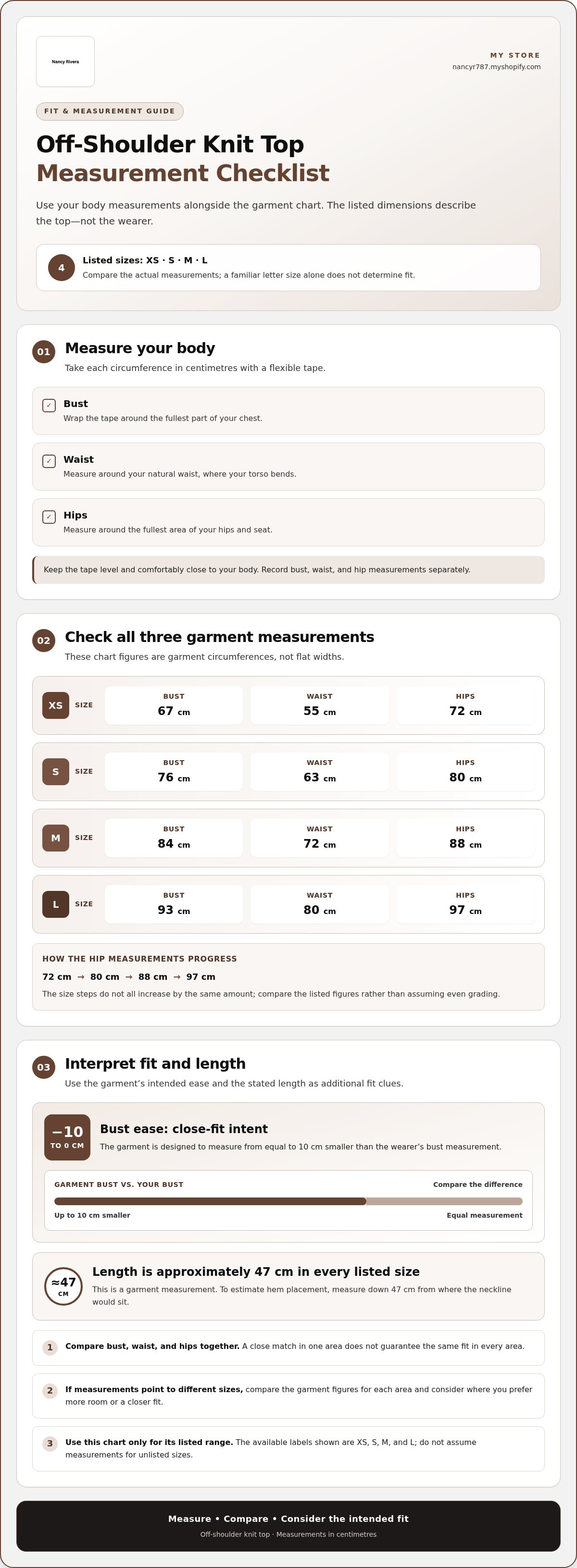
Bust, waist, hip, and length measurements
The chart gives separate garment measurements for bust, waist, and hips. Read each as a circumference, not a flat width across the garment. For sizes XS, S, M, and L, the bust figures are 67, 76, 84, and 93 cm. The waist figures are 55, 63, 72, and 80 cm. Comparing all three areas shows how the shape changes through the body, rather than relying on one measurement alone.
- XS: bust 67 cm, waist 55 cm, hip 72 cm.
- S: bust 76 cm, waist 63 cm, hip 80 cm.
- M: bust 84 cm, waist 72 cm, hip 88 cm.
- L: bust 93 cm, waist 80 cm, hip 97 cm.
Measure your body with a flexible tape, keeping it level and comfortably close. For your bust, wrap the tape around the fullest part of your chest. For your waist, measure around your natural waist, where your torso bends. For your hips, place the tape around the fullest area of your hips and seat. Record each circumference in centimetres and compare it with the corresponding garment measurement.
Garment and body measurements describe different things. The chart’s bust figure is the top’s circumference, while your bust figure is your body circumference. The design specifies negative ease of -10 to 0 cm at the bust. That means the garment may measure up to 10 cm smaller than the wearer’s bust, or match it. Compare the difference to understand the intended close fit, especially if you prefer more room.
Consider all three body areas when the measurements point to different sizes. For example, if your bust aligns more closely with one size and your waist with another, compare the garment dimensions and decide where you want a closer fit. The knit fabric and fitted hem affect how the top sits, so the fullest area alone may not predict the overall fit. Keep your measurements consistent by using the same tape position each time.
The listed garment length is approximately 47 cm across all four sizes. This is a garment measurement, not a body measurement. To estimate hem placement, hold a tape at the point where the top’s neckline would sit, then measure down 47 cm. The result gives a practical reference for the top’s length. The same listed length across XS, S, M, and L means the chart does not show additional length by size.
Needle size applies to knitting instructions, not to the finished garment’s body dimensions. The Off Shoulder Top pattern recommends 4 mm circular needles, also identified as US size 6. Those needle details describe the tools for making the pattern. They do not replace the bust, waist, hip, or length measurements used to assess a ready-made top.
The pattern gauge is 19 stitches and 26 rows in 2x2 rib over a 10 by 10 cm swatch, using 4 mm needles. Gauge describes the fabric produced with those tools and instructions. It helps explain how a knitted version reaches its intended dimensions. It is not a separate size chart, and it does not change the listed 47 cm garment length.
For a useful comparison, record your bust, waist, and hip circumferences first. Match each figure to the chart, then review the stated negative ease and 47 cm length. Keep the 4 mm needle information separate unless you are following the knitting pattern. These steps distinguish body fit, garment dimensions, and construction specifications.
MY STORE: 2026 Men S Fashion Waffle Knit Ribbed Sleeve V Neck Short Sleeve T Shirt For Daily Commuting And Casual Wear
MY STORE lists Arrival Versatile Off-shoulder Knit Womens Wear for readers comparing off-shoulder styles after reviewing garment measurements. Use the size and fit information above to identify what matters to you, then browse this women’s knitwear option. The store also lists a men’s waffle-knit V-neck short-sleeve T-shirt, an AAA jewelry chain bridal banquet dinner jewelry set, and ARTIE Men’s Wear. These are separate catalog categories, not substitutes for women’s off-shoulder knitwear. For a garment-focused browse, start with the women’s knitwear listing and compare its product details with your fit preferences. Visit MY STORE to browse the off-shoulder knitwear offering.
Choose the Fit You’ll Wear
Before choosing an off shoulder knit top, consider how you plan to wear it. A close fit may suit a simple outfit, while a layer underneath can change how the neckline and sleeves sit. Think about arm movement, neckline placement, and whether you prefer the hem tucked or loose. These preferences help turn measurements into a practical wardrobe choice.
Use the garment details as a comparison point, then focus on the cut and style that suit your intended use. After reviewing fit considerations, continue browsing MY STORE’s women’s off-shoulder knitwear listing. Choose the option that best matches your preferences, and use the product information to guide your selection.
Visit MY STORE to browse women’s off-shoulder knitwear and take your next step with a clearer idea of the fit you want.
Frequently Asked Questions
What is an off-shoulder knit top?
An off-shoulder knit top is a knitted garment with a neckline designed to sit below the shoulders, leaving the shoulder line exposed. “Knit” describes the fabric’s looped construction, while “off-shoulder” describes the neckline placement. This differs from a wide neckline that stays on the shoulders. Sleeve length, neckline width, and hem shape vary by garment, so review those details to understand how the top will sit.
How do you choose the right size for an off-shoulder knit top?
Compare your measurements with the garment’s specific chart, then consider how you want the neckline to sit. For an at-home fit check, wear the undergarments you expect to pair with the top. Move your arms forward and overhead, then sit down. If the neckline shifts or feels restrictive, reassess the size and cut instead of relying on the label alone.
What styles and necklines are available for off-shoulder knit tops?
The article describes an off-shoulder neckline and knit fabric, with ribbed detailing and a fitted hem on the Michaela top. Sleeve length, neckline width, and hem shape vary by garment.
How do you style an off-shoulder knit top for casual and dressy outfits?
For a casual look, the article suggests a close fit and considering a layer underneath. Decide whether to tuck the hem or wear it loose, and consider neckline placement and arm movement.
How do you wash and care for an off-shoulder knit top?
Machine-wash at a maximum of 30ºC and iron at a maximum of 110ºC.
Where can you buy off-shoulder knit tops in the United States?
MY STORE lists women’s off-shoulder knitwear.